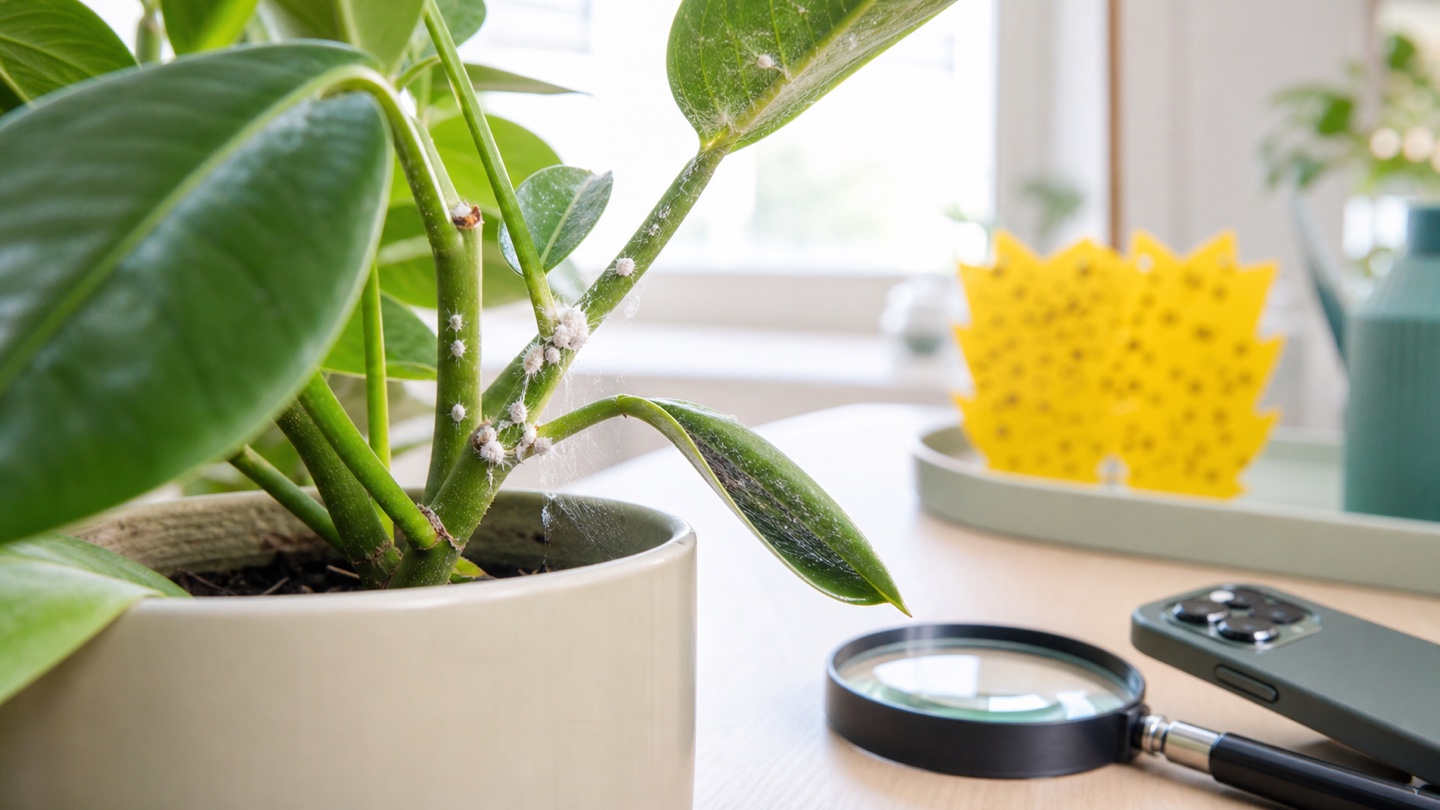
White fuzzy stuff on your plant: identifying common houseplant pests
How to tell mealybugs from mineral deposits, spider mites from dust, and fungus gnats from a real problem, plus what actually works on each.
Most pest panic starts the same way: something white, fuzzy, or crawling appears on a plant that looked fine last week. The instinct is to spray something immediately. The better first move is to work out what you are looking at, because the treatments differ and the wrong one wastes weeks while the population grows.
Take a close look, ideally with a phone camera zoomed in, and check the undersides of leaves and the joints where leaves meet stems. That is where most pests live.
Mealybugs
Looks like: small white cottony clumps, usually tucked into leaf joints, stem crevices, and the undersides of leaves. They move slowly, so many people mistake them for mold or fungus.
Also check: sticky residue on leaves or the surface below the plant. That is honeydew, and it indicates a sap-feeding pest.
What works: dab individual clumps with a cotton swab dipped in isopropyl alcohol, then treat the whole plant with insecticidal soap or neem. Repeat every 5 to 7 days for at least three rounds, because eggs hatch after the first treatment.
Spider mites
Looks like: fine speckling or stippling on leaves, a dusty or dull appearance, and in advanced cases delicate webbing between leaves and stems. The mites themselves are barely visible dots.
Also check: hold a sheet of white paper under a leaf and tap it. Moving specks confirm mites.
What works: they thrive in dry air, so raising humidity helps. Rinse the plant thoroughly, including leaf undersides, then treat with insecticidal soap or neem on a 5 to 7 day cycle. Spider mites spread fast between touching plants, so isolate early.
Fungus gnats
Looks like: small black flies drifting around the pot and rising when you water. The adults are harmless; the larvae in the soil feed on organic matter and, in numbers, on fine roots.
Also check: consistently damp topsoil. Fungus gnats are a symptom of overwatering more than a pest problem in their own right.
What works: let the top few centimeters of soil dry between waterings, which breaks the breeding cycle. Yellow sticky traps catch adults. Bottom watering keeps the surface dry while the roots still drink.
Scale
Looks like: small brown or tan bumps on stems and leaf undersides that do not brush off easily. They look like part of the plant, which is why scale is usually caught late.
Also check: sticky honeydew and sooty black mold growing on it.
What works: scrape or wipe them off with a cloth or fingernail, then treat with horticultural oil to smother the remaining crawlers. Scale is stubborn and usually needs several rounds over a month.
Thrips
Looks like: silvery or bronze streaking on leaves, distorted new growth, and tiny black flecks of excrement. The insects are slender and fast, often visible only when a leaf is disturbed.
What works: thrips are among the harder pests to clear. Isolate the plant immediately, prune the worst-affected growth, and treat repeatedly with insecticidal soap or neem. Expect a multi-week effort.
Aphids
Looks like: clusters of small green, black, or pale insects on new growth, buds, and tender stems. Usually easy to spot because they gather in groups on the softest tissue.
What works: a strong rinse of water removes most of them. Follow with insecticidal soap, and check new growth weekly for a month.
Things that are not pests
Several harmless conditions send people into unnecessary treatment.
- White crust on the soil surface or pot rim. Usually mineral deposits from tap water or fertilizer salts, not mold.
- White specks in the soil. Almost always perlite, a normal soil additive.
- A thin white fuzz on damp topsoil. Harmless saprophytic mold. It signals overwatering or poor airflow, not an infestation.
- Small brown spots on leaf undersides in neat rows. On ferns, these are spores, and a sign of a healthy mature plant.
A response that works for most infestations
Regardless of which pest you find, the sequence is similar.
- Isolate the plant away from every other plant, immediately. This matters more than the treatment itself.
- Rinse it physically in the shower or sink, focusing on leaf undersides, before applying anything.
- Treat, then repeat. Nearly all pest treatments kill adults but not eggs. A single application almost always fails. Plan on three rounds, 5 to 7 days apart.
- Check the neighbors. Inspect every plant that was within touching distance, and any plant that shared a saucer or a shelf.
- Inspect new plants before they join the collection. Two weeks of quarantine prevents most outbreaks entirely.
Get a second read before you treat
Pest identification from a single blurry photo is unreliable, and the cost of a wrong guess is weeks of ineffective treatment.
Planture's Diagnose is built for this. It asks for the whole plant, the affected leaves, and a second angle, so the symptom is assessed with context rather than from one close-up, and it organizes the result into likely issues, treatment options, and prevention notes. If the situation is ambiguous, AI Botanist lets you describe the details a photo cannot show — when it started, what you have already tried, how the plant is watered. And because scans stay in the plant's history, a recurring infestation months later is something you can compare against rather than diagnose from scratch.
For severe infestations or valuable plants, it is still worth consulting a local nursery or extension service before applying chemical treatments.