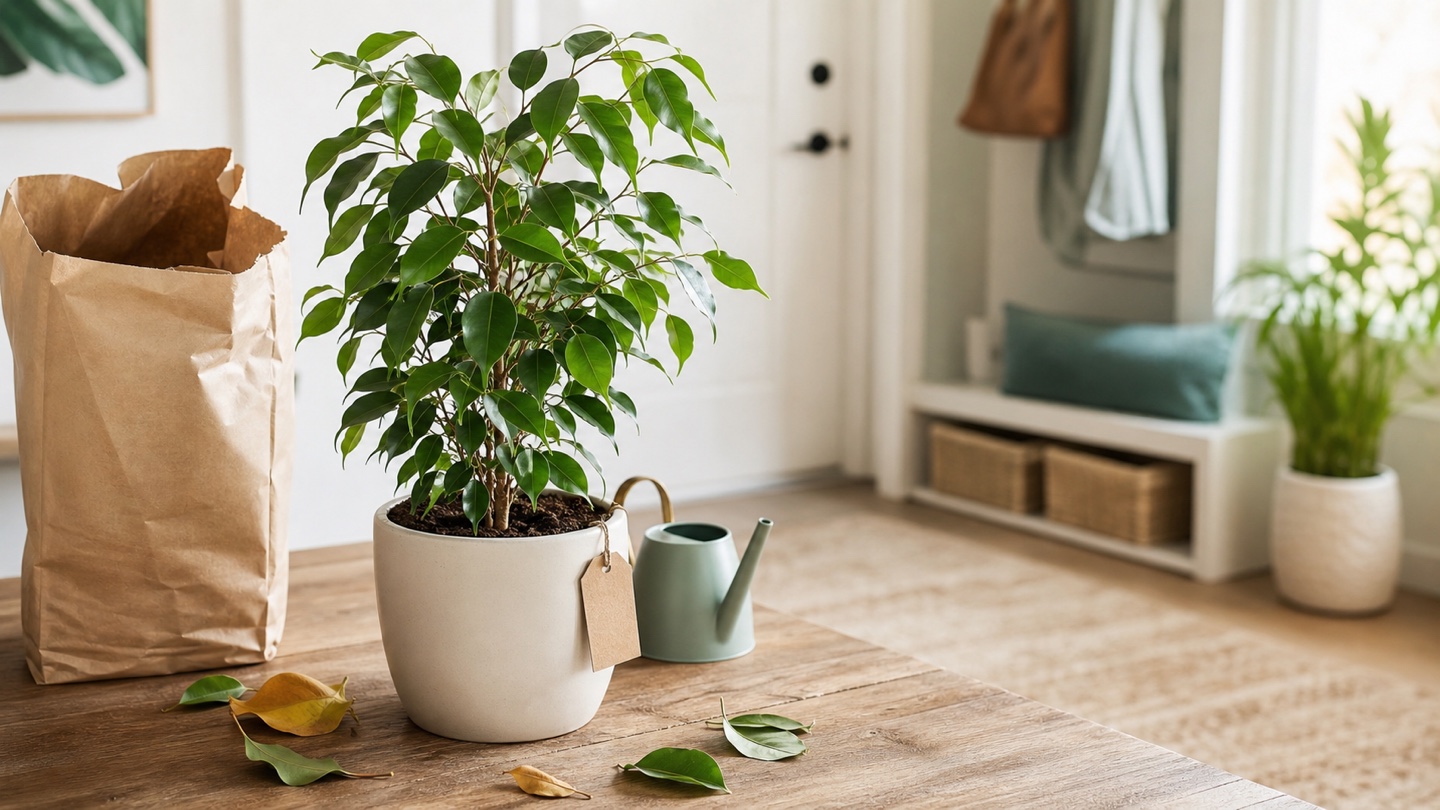
Why your new plant is dropping leaves after you brought it home
Leaf drop in the first few weeks is usually acclimation, not failure. Here is how to tell the difference and what to do while the plant adjusts.
You buy a healthy plant, bring it home, and within two weeks it starts dropping leaves. The natural conclusion is that you did something wrong. Usually you did not — but what you do next determines whether the plant recovers or actually declines.
Acclimation is normal
Plants sold in shops were almost always grown in commercial greenhouses: high, consistent light, stable humidity, controlled temperature, regular feeding. Your home matches none of those conditions.
When light drops, a plant cannot sustain all the leaves it grew under better conditions, so it sheds the ones that cost more energy than they produce. This is not damage. It is the plant resizing itself to its new environment, and it typically settles within two to four weeks.
The leaves that go first are usually the oldest and lowest, or the ones deepest inside the canopy.
What actually changed
Understanding which change is responsible helps you avoid overcorrecting.
- Light. The largest and most common factor. Even a bright window in a home is often a fraction of greenhouse light.
- Humidity. Retail and greenhouse environments are far more humid than a heated or air-conditioned room. Tropical plants feel this most.
- Transport shock. Cold air on the walk to the car, a hot car interior, or being wrapped in a sleeve for a few hours all cause stress that appears days later.
- Temperature swings. A spot near a radiator, an air conditioning vent, or a drafty door creates fluctuations no greenhouse plant is used to.
- Watering change. The nursery watered on a professional schedule matched to their conditions. Yours will necessarily be different.
What not to do
Almost every way a new plant is lost comes from intervening too hard, too early.
- Do not repot immediately. This is the most common mistake. Repotting adds root disturbance on top of environmental stress. Unless the plant is severely root-bound or sitting in soaking, rotten soil, wait at least a month.
- Do not fertilize. A stressed plant is not growing, cannot use the nutrients, and the excess accumulates as salt in the soil. Nursery plants usually arrive with several weeks of fertilizer already in the mix.
- Do not water more to help it. Leaf drop looks like thirst, but a plant with fewer leaves in dimmer light needs less water than it did at the shop. Adding water is how acclimation becomes root rot.
- Do not keep moving it. Every move restarts the adjustment. Pick the best spot you have and leave it there for a month.
What to do instead
- Choose the brightest spot the plant can tolerate without direct midday sun, and commit to it.
- Water by checking the soil, not on the shop's schedule. Two knuckles deep and dry means water; damp means wait.
- Remove fully dead leaves, and leave yellowing ones alone until they are done. The plant is still reclaiming resources from them.
- Keep it away from vents, radiators, and drafty doors.
- Wait. New growth appearing is the signal that acclimation is finished. That is the moment to consider repotting or feeding, not before.
When it is not acclimation
Some leaf drop is a real problem. Look for these signs:
- New growth is affected too. Acclimation sheds old leaves. If fresh growth is browning, wilting, or deformed, something else is happening.
- The stem is soft or the soil smells sour. That is root rot, usually from overwatering or a pot with no drainage, and it needs action now rather than patience.
- Visible pests. Check leaf undersides and leaf joints for webbing, white cottony clumps, or brown bumps. Shop plants sometimes come with company.
- It is still dropping leaves after six weeks, with no new growth. At that point the spot is likely too dark, or watering is off.
- Leaves drop suddenly and en masse within days. That points to cold damage during transport or a severe watering event, not gradual adjustment.
Buy better next time
Much of this is avoidable at the shop. Check the leaf undersides for pests before buying, avoid plants in soaking wet or bone-dry soil, skip anything with mushy stems, and think about where the plant will live before you pick it — not after.
Planture helps at both ends of that. Plant ID identifies a plant before you commit and shows its light, watering, and difficulty details, and the Light Meter tells you whether the spot you had in mind actually suits it. Once the plant is home, saving it to My Plants with a reminder rhythm you set deliberately keeps you from watering on anxiety, which is the main risk during acclimation. If the decline looks like more than adjustment, Diagnose takes several angles rather than one photo, and the saved history means you can see exactly how long the plant has been struggling instead of relying on memory.
Most new plants look worse before they look better. The ones that recover are usually the ones that were left alone.