How often should you actually water houseplants?
There is no universal watering schedule. Learn what actually sets the interval for your plant, in your room, and how to check instead of guess.
"Water once a week" is the most repeated piece of plant advice and the most common reason houseplants die. Not because the number is wrong, but because a number cannot be right on its own. The same pothos might need water every four days in a bright summer room and every twelve in a dim corner in January.
The interval is an output, not an input. Here is what produces it.
What actually sets the schedule
Six factors decide how fast a pot dries out. Change any one and the interval changes with it.
- Light. The single biggest driver. More light means more photosynthesis, more water use, faster drying. A plant moved two meters further from a window can double its watering interval.
- Pot material. Terracotta breathes and dries out quickly. Glazed ceramic and plastic hold moisture far longer. The same plant in the same room can differ by a week between the two.
- Pot size. An oversized pot holds more soil than the roots can drink, and that surplus stays wet. Large pots on small plants are a frequent cause of root rot.
- Soil mix. Chunky, airy mixes with bark or perlite drain fast. Dense, peaty potting soil holds water for days longer.
- Season. Growth slows in autumn and winter as daylight drops. Watering usually needs to slow with it, often by half.
- Humidity and airflow. A dry, heated room in winter or a fan blowing across a shelf pulls moisture out faster than still, humid air.
Check the soil, not the calendar
The reliable method takes three seconds and beats any schedule.
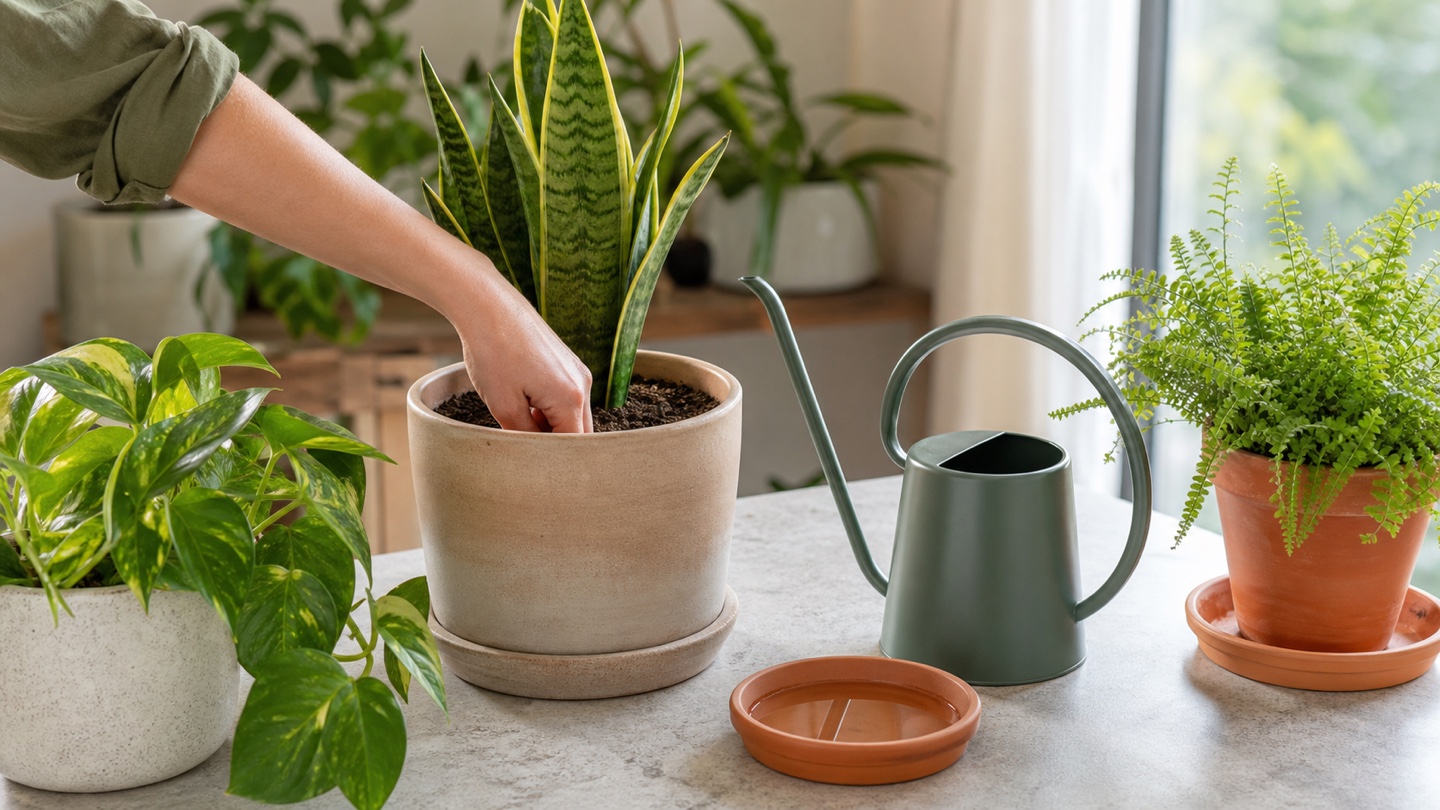
- Finger test. Push a finger two knuckles into the soil. If it comes out with damp soil clinging to it, wait. If it is dry at that depth, most common houseplants are ready.
- Weight test. Lift the pot right after watering and again a few days later. The difference is obvious once you have felt it twice, and it works for pots too dense to poke.
- Wooden skewer. Push it to the bottom, pull it out, and look. Dark and damp means wait. This is the most accurate check for deep pots.
Surface dryness means nothing. The top centimeter of soil dries within hours in most rooms while the root zone is still saturated.
Water thoroughly, then stop
When you do water, water properly. Small, frequent sips keep the top of the soil wet and leave the deeper roots dry, which trains roots to stay shallow.
Pour slowly until water runs out of the drainage hole, let it drain fully, and empty the saucer. A pot sitting in standing water is the fastest route to root rot. If your pot has no drainage hole, either drill one or use it as a cachepot with a plastic nursery pot inside.
Rough starting points
These are starting points to be adjusted after two or three cycles of observation, not schedules.
- Succulents and cacti: every 2 to 4 weeks, and less in winter. Let the soil dry completely.
- Snake plant, ZZ plant: every 2 to 3 weeks. These tolerate neglect far better than attention.
- Pothos, philodendron, monstera: every 7 to 10 days, when the top few centimeters are dry.
- Ferns, calathea, peace lily: every 3 to 6 days. These prefer consistently, but not permanently, moist soil.
- Newly repotted plants: water in well once, then return to the plant's normal rhythm. Repotting is not a reason to water more.
Adjust twice a year, not never
The two moments most worth a deliberate review are the shift into autumn and the shift into spring. Daylight changes faster than most people's habits do, and the classic winter overwatering problem is a summer schedule that was simply never revisited.
Turn observation into a routine
Once you know your plant's actual interval, the challenge stops being knowledge and becomes memory. That is the gap Planture is built to close.
The Water Meter helps you think through a plant's needs rather than reaching for a generic number. Reminders let you set the interval you arrived at yourself, with a repeat rhythm and a time of day you are actually near your plants, and the Reminders tab shows what is due, overdue, and done. Because completed care becomes part of the plant's history, you can look back after a season and see whether your interval was right — which is the only way a schedule ever gets better.